TL;DR
Vending machines, micro markets and smart coolers all sell food without staff. Three things decide which one a site needs: the location, the products on offer, and how many shoppers it sees each day. Vending machines suit uncontrolled public locations selling snacks and beverages. Micro markets pay off in workplaces with more than 150 people. Smart coolers cover the sites in between, from about 50 people, with fresh food and the stock locked, which helps explain why they now make up 33.5% of the equipment US operators deploy. (Source: Vending Market Watch, State of the Industry 2026) The five questions below do the matching.
A new account calls. 120 people on two floors, a breakroom the size of a parking space, and a facilities manager who wants fresh food by next month.
Vending machine, micro market or smart cooler?
Three things decide the answer:
- It sets the level of security the stock needs. Only a vending machine belongs in an uncontrolled public location.
- Fresh food rules out vending machines and points to a smart cooler or a micro market.
- Shoppers per day. The common rule of thumb: a micro market pays in workplaces with more than 150 employees or shoppers around it. Fewer potential buyers usually point to smart coolers, vending machine arrays, or both.
This guide compares the three formats on those factors, then gives you five questions to match each format to a site
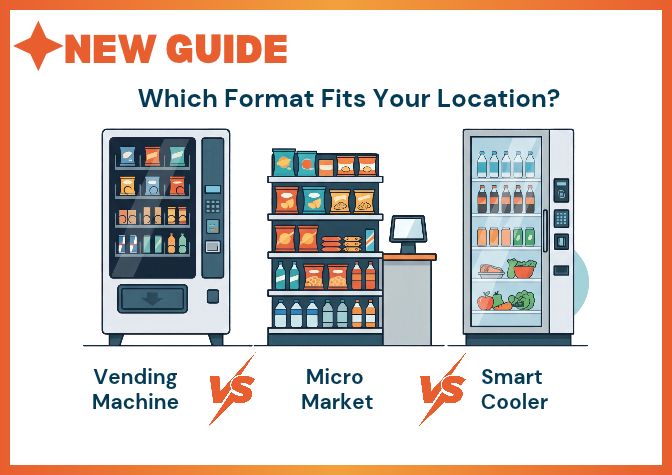
The Three Formats Side by Side
| Vending machine | Micro market | Smart cooler |
How the shopper buys | Selects a product, the machine dispenses it | Walks open shelves, scans items at a self-checkout kiosk | Taps to unlock the door, takes items, closes it, charged for what left the shelf |
Typical assortment | About 40 products | 150 to 400 products | Fresh meals, drinks and snacks in one or more cabinets |
Stock exposure | Locked behind glass | Open shelves, honor system | Locked until payment, every item tracked |
Floor space | One machine footprint | A dedicated area with shelving, coolers and a kiosk | One cabinet footprint per unit |
Strongest in | Uncontrolled public locations selling snacks and beverages | Controlled-access workplaces with 150+ people | Sites of 50+ people, semi-public or 24/7, that want fresh food |
Watch for | Narrow range, lower ticket | Shrinkage, 4% or more for most operators | Recognition accuracy decides the charge |
(Sources: Nayax estimate via William Blair, 2025; NAMA State of the Industry; Automatic Merchandiser, 2025 Operator Survey)
Where a Vending Machine Still Earns Its Place
Vending machines remain the right call mainly in uncontrolled public locations, where snacks and beverages are the main offering. The product is locked away until it’s paid for, and the machine takes up the least floor of the three.
The trade-off is range and revenue per machine. About 40 products fit, and an average machine brings in about $583 a month in the US (Source: NAMA, 2024–2025 census, published 2026) and about €440 a month in Europe (Source: calculated from EVA 2024 data, published October 2025).
Where a Micro Market Earns Its Floor Space
A micro market gives a large workplace the widest range: 150 to 400 products, from snacks to full meals. Shoppers spend more when they can browse. Micro markets show a 30% share of high-ticket items and 53% higher spend per visit. (Sources: William Blair; Cantaloupe via Vending Times)
The open shelf has a cost, and it has grown significantly since COVID. In Automatic Merchandiser’s 2025 operator survey, 60% of operators reported shrink of 4% or more: 32% at 4%, 21% at 5–6% and 7% above 7%, with 5% unsure. (Source: Automatic Merchandiser, 2025 Operator Survey) The average across retail is 1.6%. (Source: National Retail Federation, 2022 data) The honor model works best where the population is known and access is controlled, and it weakens in high-turnover or public locations. (Source: William Blair, 2025)
That makes the micro market a strong fit for a badge-access office with hundreds of employees and a room to give. It fits a lobby, a gym entrance or a transit hub much less well.
Where a Smart Cooler Fits
A smart cooler covers the sites in between: offices of 50 people or more, the hotel lobby, the campus building, the gym that’s open at 5 a.m. In higher-shrinkage locations, it can also work as a secured micro market.
- Fresh food with the stock secured. The door unlocks only for a shopper with a valid payment, and the system charges for exactly what was taken.
- One cabinet of floor space. A site that can’t give up a room can still give up a wall.
- 24/7 without staff. At Sport Studio PRIMA in Karlovy Vary, SmartVendor runs an Innovendi® smart cooler in a shared building entrance, open around the clock, selling fresh meals and protein products to gym members, office tenants and visitors. Read the SmartVendor case study
The business case rests on four numbers. SHEKEL reports 99.99% uptime, sub-1% shrinkage, up to 99.8% product recognition accuracy and ROI in under 18 months on Innovendi®. New units go live in hours.
Two questions to put to any smart cooler vendor: recognition accuracy and total cost of ownership. A smart cooler is only as profitable as its count of what left the shelf, and what it costs to run.
Five Questions That Pick the Format
Run these for every new site before you quote it.
- Who can reach the location, and when? Uncontrolled public location: a vending machine. Known population, controlled access: a micro market or a smart cooler. Semi-public or 24/7, such as a shared lobby, hotel or gym: a smart cooler, which keeps the stock locked.
- How many potential shoppers will the site see? More than 150 employees or shoppers: a micro market typically pays. Fewer: smart coolers, vending machine arrays, or both. A smart cooler suits sites from about 50 people.
- What will the site sell? Fresh food rules out vending and points to a smart cooler or a micro market. Around 40 shelf-stable products: vending. Hundreds: micro market. A focused fresh range of drinks, meals and snacks: smart cooler.
- How much floor can the host give you? A room supports a micro market. A wall supports a smart cooler or a vending machine.
- How much loss can the margin absorb? Most operators see 4% or more shrink on open micro markets. (Source: Automatic Merchandiser, 2025) SHEKEL reports sub-1% shrinkage on Innovendi® smart coolers.
Where the answers split, for example a large office that is also open to visitors, you can split the site: a micro market for employees, a smart cooler in the visitor lobby.
Changing Format Can Start With the Cooler You Already Own
If your fleet already includes glass-door coolers, the WeightAI™ integration kit adds weight-based product recognition to supported existing equipment, which turns a standard cooler into a smart cooler. Moving a site to the middle format can start with the cooler already in the building rather than a new purchase. See the integration kit
Before You Quote the Next Site
Take the five questions to your next site visit. If you want a second opinion on a specific location, SHEKEL will review the site with you and run the payback on your own numbers. Talk to the SHEKEL team
The location decides the format. The format decides the margin.
Frequently Asked Questions
What is the difference between a smart cooler and a micro market?
A micro market is an open-shelf store with a self-checkout kiosk, typically carrying 150 to 400 products in a dedicated area. A smart cooler is a locked, refrigerated cabinet that unlocks for a paying shopper and charges for exactly what was taken. Micro markets offer the widest range. Smart coolers secure the stock and fit in a single cabinet footprint.
Smart cooler vs vending machine: which should an operator choose?
Choose a vending machine for uncontrolled public locations selling snacks and beverages. Choose a smart cooler when the site wants fresh meals or a wider, higher-ticket range and still needs the stock locked. Smart coolers now account for 33.5% of equipment US operators deploy. (Source: Vending Market Watch, 2026)
Micro market vs vending machine: which makes more money?
Micro markets sell a wider range and show a 30% share of high-ticket items. (Source: William Blair) A traditional vending machine averages about $583 a month in the US. (Source: NAMA, 2024–2025 census, published 2026) Micro markets also carry more loss: 60% of operators report shrink of 4% or more. (Source: Automatic Merchandiser, 2025) The right choice depends on location, products and daily shoppers. Micro markets typically pay in workplaces with more than 150 people.
Which unattended retail format has the lowest shrinkage?
Formats that lock the stock until payment lose the least. Vending machines and smart coolers both secure the product. SHEKEL reports sub-1% shrinkage on Innovendi® smart coolers, against 4% or more for most operators running open micro markets. (Sources: SHEKEL; Automatic Merchandiser, 2025)
Can a smart cooler run 24/7 without staff?
Yes. The stock stays locked until a shopper pays, and every item is tracked, so a smart cooler can run unstaffed in lobbies, gyms, hotels and campus buildings. SmartVendor runs one 24/7 in a shared building entrance in Karlovy Vary. For fully uncontrolled public locations, a vending machine remains the more secure choice.
Can I turn an existing cooler into a smart cooler?
Often, yes. The WeightAI™ integration kit adds weight-based product recognition to supported existing coolers. Compatibility depends on the model, so confirm yours with the SHEKEL team.
“Lorem ipsum dolor sit amet, consectetur adipiscing elit, sed do eiusmod tempor incididunt ut labore et dolore magna aliqua.”