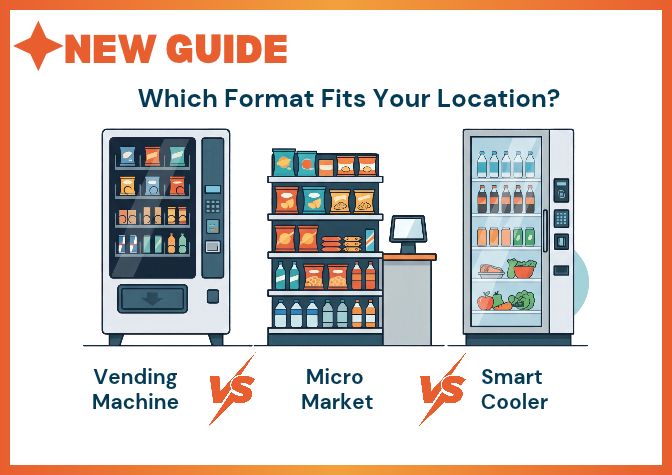
A smart cooler is a refrigerated retail unit that recognizes products as a shopper removes them and charges automatically, with no cashier and no checkout line. The decision that defines a smart cooler in 2026 is how it knows what was taken; camera-based vision or weight-based sensing. That single choice sets the accuracy, the data-compliance exposure, and the quality of inventory data the operator gets back.
How does a smart cooler work?
A weight-based smart cooler works in four steps: the shopper authenticates with a payment method to unlock the door, takes what they want, shelf-level sensors register each weight change and identify the product removed, and the door closes with a charge for exactly what left the cooler.
The recognition happens at the shelf, inside the machine. The shopper experiences nothing more than open, take, go, a transaction that completes in under 30 seconds. There is no scanning, no app-fumbling at a kiosk, and no waiting for a vision system to resolve what was picked up.
The contrast is with two older models. Traditional vending dispenses one item per selection through a mechanical coil. Camera-based “just walk out” systems watch the shopper with computer vision. Weight-based sensing sits between them in cost and above both in a specific dimension: it measures the physical shelf directly rather than inferring it.
What is the difference between bin weight sensing and WeightAI?
Weight-based coolers come in two kinds. The first uses native bin weight: a load cell under each bin reports how many grams left, and the system divides that by the product’s listed weight to estimate a count. That works when each bin holds a single product and shoppers take one item at a time. It breaks down when two products weigh almost the same, when a shopper takes several items at once, when an item is put back in the wrong bin, or when cold and condensation shift the reading.
WeightAI adds a recognition layer on top of the sensor. It reads the full weight signal across the shelf and matches it to a specific SKU. That lets it separate products with close weights, handle multi-item picks and misplaced returns, and flag a product sitting in the wrong slot. A bin scale reports grams. WeightAI reports which product, how many, and from where.
Why is shrinkage higher in unattended retail?
Shrinkage runs higher in unattended formats because open-access shelves remove the deterrent of a staffed checkout. Retail-wide shrinkage averages about 1.6% of sales, but micro markets routinely exceed it.
The figures are well documented. Equity research from William Blair reports that 89% of micro-market operators see above-benchmark shrinkage, attributing it to the absence of staff oversight. The vending industry’s own State of the Industry survey puts average micro-market shrink near 4%, more than double the retail-wide rate measured by the National Retail Federation.
1.6% Average retail shrinkage, all formats (NRF) | ~4% Average micro-market shrink (NAMA State of the Industry) | 89% Micro-market operators above shrink benchmark (William Blair) |
This is the loss operators talk about, because it is visible. It shows up when the cash collected does not match the product gone. But it is not the largest loss in the category, and it is not the one most VMS dashboards are built to catch.
What is phantom inventory, and why does it cost more than theft?
Phantom inventory is the gap between what an inventory system reports as in-stock and what is physically on the shelf. It is the leading cause of out-of-stocks, and out-of-stocks have cost retailers roughly 4% of sales for decades.
The mechanism is quiet. A system shows product on hand; the shelf is empty. The reorder never triggers, the shopper finds nothing, and the sale is lost without ever appearing as a loss. Research by Gruen and Corsten established the ~4% sales-loss figure for out-of-stocks, and industry analyses attribute the majority of those events to inventory records that no longer match reality.
In unattended retail this compounds. A route driver restocks based on what the VMS reports was sold, a telemetry estimate derived from transaction logs and mechanical counts. When that estimate drifts from the physical shelf, the driver brings the wrong product, in the wrong quantity, to the wrong machine. The empty slot stays empty until the next visit.
Telemetry estimates the shelf. It does not measure it. That gap is where both shrinkage and stockouts hide.
Bin weight vs. WeightAI vs. camera vs. telemetry: how do they compare?
The four approaches differ most in what they actually measure: grams, SKU-matched weight, pixels, or payment logs. That determines their accuracy, data-compliance exposure, and infrastructure cost.
| Native bin weight | WeightAI™ | Camera vision | Telemetry (VMS) |
What it measures | Grams removed per bin | Weight signal matched to a specific SKU | Visual image of shopper | Reported sales & counts |
Inventory basis | Estimated count (grams ÷ item weight) | Actual depletion, per SKU | Inferred from images | Estimated from sales |
Cameras required | No | No | Yes | No |
Personal data captured | None | None | Shopper images | None |
GDPR exposure | Compliant by design | Compliant by design | Ongoing management | Low |
Infrastructure load | Low bandwidth | Low bandwidth | High bandwidth | Low |
Similar weights & multi-item picks | No | Yes | Partial (occlusion) | Not applicable |
Catches phantom inventory | Partial | Yes, measures the shelf per SKU | Partial | No it is the cause |
Where does weight verification change the operator’s data?
Weight verification replaces estimated inventory with measured inventory, which changes four operational decisions: what is actually in stock, whether the right product is in the right slot, whether the machine is healthy, and what each route truck should carry.
Each follows from the same property, the shelf is being weighed, not guessed:
- Weight-verified inventory. Stock levels reflect actual depletion at the shelf rather than a transaction estimate, so the count a driver sees is the count that exists.
- Planogram verification. Weight confirms the correct SKU sits in the correct slot and flags mismatches, so a wrong-product restock is caught at the shelf instead of at the next audit.
- Machine health monitoring. Temperature, network connectivity, and mechanical faults surface from inside the machine, before they become a spoiled load or a dead unit.
- Route intelligence. Restock decisions are made on real shelf weight and depletion patterns, so trucks carry what locations actually need, when they need it; fewer wasted visits, fewer empty slots between them.
The data pays only when someone acts on it. SHEKEL’s intelligence layer, turns shelf data into day-to-day decisions:
- Sales velocity. What sells, when and how fast, by SKU, day and hour.
- Slot performance. Which SKUs are holding a slot they have not earned.
- Location profitability. How profitable each location is, down to the shelf and the slot.
Why do smart coolers earn more per transaction?
Smart coolers earn more because they hold higher-value SKUs and fresh food that traditional vending cannot and the transaction data backs it up.
William Blair’s unattended-retail research shows smart stores averaging $4.25 per transaction against $2.11 for traditional vending, an increase of more than 100% per transaction. The North American micro-market segment is projected to reach roughly $14.7 billion in 2026, growing at about 10% annually through 2033. The economics are driving the shift.
$4.25 Avg. smart-store transaction vs. $2.11 vending (William Blair) | $14.7B Projected 2026 North America micro-market size | ~10% Forecast CAGR, 2026–2033 |
The takeaway
Smart coolers changed the economics of unattended retail; higher tickets, fresh food, more revenue per location. The next gain is in the data underneath. A cooler that measures its own shelf, rather than estimating it from sales logs, gives the operator inventory they can act on: accurate counts, verified planograms, healthier machines, smarter routes. That is the difference between knowing what a machine sold and knowing what is actually on its shelf right now.
Frequently asked questions
Do smart coolers use cameras?
Not all of them. Weight-based smart coolers identify products through shelf-level weight sensing, so they capture no images of shoppers or their selections. Camera-based systems use computer vision and do record visual data at the point of purchase.
Are smart coolers GDPR-compliant?
Weight-based smart coolers are compliant by design, because they collect no biometric or personal data when a shopper makes a purchase. This is a practical reason they are favored across European markets, where camera-based recognition carries additional compliance obligations.
How accurate is a smart cooler?
Accuracy depends on the layer above the sensor. Basic bin-weight systems count by dividing grams, so look-alike weights and multi-item picks cause errors. WeightAI reaches 99.8% product-recognition accuracy because it identifies the SKU from the weight signal. Because it measures weight rather than reading an image, it also avoids the lighting, occlusion and crowding errors that affect cameras.
Is a weight-sensing bin the same as WeightAI?
No. A weight-sensing bin measures how much weight left the shelf. WeightAI identifies which product left, including items with near-identical weights and several items taken at once.
What is the difference between a smart cooler and a micro market?
A micro market is an open, unattended store format with a self-checkout kiosk. A smart cooler is a single enclosed unit that recognizes items automatically on removal. A smart cooler can stand alone or sit inside a micro market, and unlike an open kiosk it controls access and verifies every pick.
Can an existing cooler be upgraded to a smart cooler?
Yes. Retrofit and integration kits add weight-based intelligence to standard coolers and cabinets, letting operators upgrade existing hardware without replacing it.
How does a smart cooler reduce out-of-stocks?
By measuring actual shelf weight rather than estimating depletion from sales logs, a weight-based cooler reports what is genuinely running low before a service visit. That closes the phantom-inventory gap that causes most out-of-stocks in unattended retail.
THE INTELLIGENCE LAYER
WeightAI™ is the weight-based intelligence embedded inside smart coolers, vending systems, and autonomous retail machines — measuring the shelf from inside the machine, at the intelligence layer. Learn how it works at shekel.ai.
SOURCES
- National Retail Federation / Statista — U.S. median retail inventory shrinkage rate (~1.6% of sales).
- William Blair — “Overcoming Theft and Shrinkage in Unattended Retail Operations” (89% of micro-market operators above shrink benchmark).
- NAMA / Automatic Merchandiser — State of the Industry Annual Report 2025 (~4% average micro-market shrink).
- Gruen, T. & Corsten, D. — research on retail out-of-stocks (~4% of sales lost to OOS).
- William Blair — “Unattended Retail: Driving Incremental Growth of Electronic Payments,” citing Cantaloupe data ($4.25 smart-store vs. $2.11 vending average transaction).
- Persistence Market Research — North America Micro Market size forecast (~$14.7B in 2026; ~10.2% CAGR 2026–2033).
Note: market-size projections are third-party estimates and are presented as directional category context, not audited figures.
“Lorem ipsum dolor sit amet, consectetur adipiscing elit, sed do eiusmod tempor incididunt ut labore et dolore magna aliqua.”